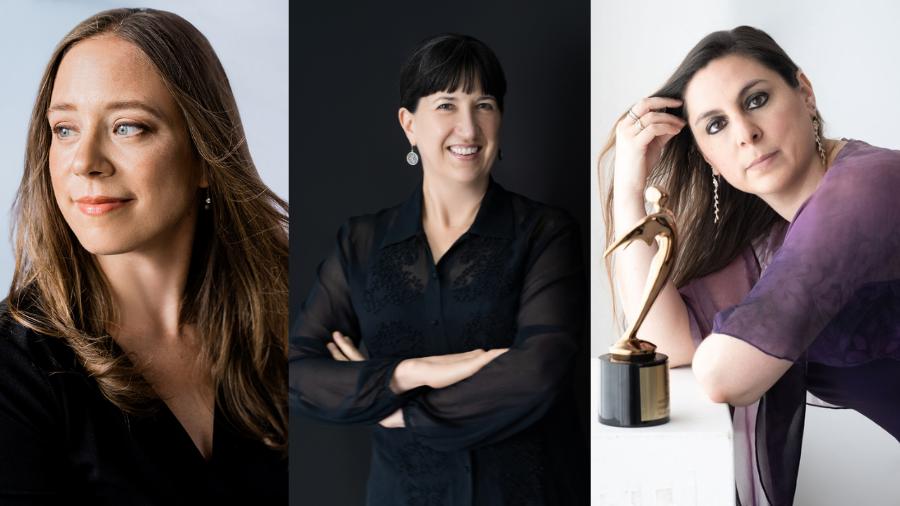
The third installment in All Classical Radio’s award-winning Recording Inclusivity Initiative, AWAKEN, continues the network’s monumental effort to rectify inequities in classical music recording, casting women composers in the spotlight and inviting listeners from across the globe to hear imaginative new music. Award-winning and GRAMMY®-nominated performers tackle these works to send a powerful message regarding the importance of artistic collaboration.
Today, the composers of AWAKEN are our featured artists in “The Inside Story,” a blog series exploring the inner workings and personalities of our composers and performers. Read on for a deep dive into the musical minds of Nicole Buetti, Kirsten Volness, and Nancy Ives…
Where did your love for classical music originate? Did your journey to become a composer follow a natural course?
NB: My first memory of classical music was sitting in an old cathedral with my parents when I was a little girl, only 5 years old. A pipe organist was rehearsing and he was playing Bach’s Toccata and Fugue in D-minor and I remember how the music filled the cathedral. The sound was transformative and I knew I needed to learn how to create something like that.
Piano lessons came first, with me annoying my teacher every week asking to learn the Toccata and Fugue, and her telling me I actually had to learn the basics first. But I was easily bored with playing Hot Cross Buns and Twinkle, Twinkle Little Star so I began writing my own tunes. Once I learned to notate music (by hand) I would write all my ideas in a small notebook. Eventually, I composed pieces and performed them in recitals and I even composed my high school band’s graduation song. After that, the natural course was to study music theory and composition in college. That led me down many different paths including chamber music, orchestral music, film scoring, big band music and children’s music. Exploring all of these diverse styles of music has been an incredible learning and growth experience that I continue to this day.
KV: When I was 4, my favorite artists were Stevie Wonder and Cyndi Lauper. I remember doing laps in my Fisher Price roller skates, playing the sax solo from “Careless Whisper” on my Casio keyboard each time I rode by. To be honest, Quincy Jones got me excited about making music. It was around that time that I asked my parents for piano lessons and the Suzuki method brought classical music into my life. I still played my Mozart over a rumba beat with syncopation because I thought it was boring. I later fell in love with Chopin, Ravel, Debussy, Barber… but reached a point at which practicing felt like an unending quest for perfection. My orchestration teacher Judith Lang Zaimont invited me to try composition and it felt so liberating that the goal was now to find my own weird, imperfect voice instead — to dream up my own stories. Nina Simone taught me that as an artist, having a platform to engage with the current moment, to process the world we live in with the communities we live among, feels more rewarding than living in the museum of dead, white, European men — even if Nina would have rather played Bach at Carnegie Hall.
NI: I’ve played the cello since I was six years old and got all of my degrees (through a D.M.A.) in Cello Performance, so my journey to become a composer has not been typical. I was very active as a composer in college at the University of Kansas, where I had supportive teachers, and I continued to write a steady trickle of music when I moved to New York City. My pieces were all performed — groups I played in were receptive and that made me very fortunate — but I still fizzled out… I now see that I simply hadn’t found my voice yet. I had very narrow ideas about what music being written in our tines should be like, ideas that I think had their origins in a quelling mix of immaturity and dogmatic thinking. It took me a while to grow out of that, and it’s possible that it took moving to Portland. There’s something about the openness and the flavor of vibrant creativity here that has opened up channels of inspiration and expression for me. I never stopped thinking about composing — it was like an unformed soup of thoughts and ideas sloshing around in my subconscious — but when Doug Jenkins of Portland Cello Project asked me to write a short cello quartet from a snippet of an Elliot Smith song, it was a transformational catalyst that has accelerated into what I now see as my true life’s work.
Who are some of your favorite women composers? What lesser-known artists do you think classical listeners should be more familiar with?
NB: Ruth Gipps is a wonderful composer and, like me, enjoyed composing for some of the lesser featured instruments. She composed a wonderful piece called Leviathan for contrabassoon and orchestra that was dedicated to Val Kennedy, contrabassoonist of the London Philharmonic. (I’m actually performing this piece at a music festival this summer.) Another extraordinary composer is Joan Szymko. Her piece, Shadow and Light, is one of the most emotionally powerful pieces I’ve ever heard (and performed). I would highly recommend the works of both of these composers to listeners.
KV: I gravitate toward music that blurs stylistic boundaries. Kelly Moran writes mesmerizing piano textures, often using prepared piano samples she creates herself with other electronic elements. Nala Sinephro creates luscious sound worlds and develops musical ideas in interesting ways. Laura Cetilia and Kristina Wolfe write music swimming in overtones, sometimes offering the simplicity of quiet, spectral wonder, sometimes complete sublimation toward deeper listening. I’ve commissioned works by The Honorable Elizabeth A. Baker and Carolina Heredia which were so different in sound and intent, but so true to their authors’ ethos, interests, and life stories. My non-binary colleagues need mentioning as well — Rosśa Crean and Michael Genese write gorgeous music for voice and strings and much more.
AWAKEN is also an album about collaboration–between musicians, organizations, and communities. What does your dream artistic collaboration look like?
NB: I am extremely fortunate to have had the opportunity for a dream collaboration. In 2020, during the COVID-19 Pandemic, I had a distanced lunch with Rebekah Phillips who was the executive director of the then Portland Columbia Symphony (now Orchestra Nova Northwest). I shared an idea with her about my vision of creating an online musical outreach series for children and how I wished that I could someday afford to bring the program to life. Thanks to our amazing donors and sponsors, we were able to create something truly special; our Meet the Instruments series which just celebrated its 5-year anniversary. Scotty Barnhart once told me, “Work with people you like and trust.” That is the best advice, and I am so fortunate that I had the pleasure to do just that for Meet the Instruments. My new dream is to have the opportunity to create another meaningful project like this one with incredible musicians (and friends).
KV: I’ve achieved a few dream collaborations that I’d love to build upon. My opera “Letters That You Will Not Get: Women’s Voices from the Great War” was created and performed entirely by women and non-binary artists, telling stories of women living through World War I in their own words. Portland Jazz Composers Ensemble commissioned a song cycle about the geological and historical significance of Mt. Tabor Park, an extinct volcano, and performed it in the caldera amphitheater for 1000+ people while being broadcast on community radio. My “space jam band” as I called it, Meridian Project, created performances with astrophysicists about current research and cosmology at planetariums and observatories indulging my love of science. I’ve been writing and performing operas with people who have experienced housing insecurity with Tenderloin Opera Company for 15 years and I’ve seen creativity empower people and change lives. I’ve always wanted to work with Björk, but who wouldn’t?! She’s the best.
NI: It was the process of working on Celilo Falls with Joe Cantrell and Ed Edmo that truly taught me how profound collaboration could be. An earlier version of the piece was inspired by the collaborative spirit of the late Yaakov Bergman. There are so many threads of collaboration that went into bringing the recording of this work to fruition that I can’t help but think of a very on-the-nose analogy. It’s as if many streams came together into one huge river, just like the Columbia, like N’Chewana.
Ed Edmo’s poetry formed the personal heart and Joe Cantrell’s universal vision informed the larger scope. Because this story is not mine to tell, getting buy-in in the form of blessings from tribal elders was an absolutely critical step, and Joe Cantrell was instrumental in that, speaking with members of the community and introducing me to people who frankly needed to size me up before they could trust me to create this vehicle for a story so intimately connected to their own lives. This is a story of people in our region here in the Pacific Northwest who have roots here dating back millennia, but it is also a story of so many clashes between the needs of modernizing societies and industrial progress with the traditions and needs of their indigenous people. In that way, it is a truly universal story.
To bring the work to life with the full orchestra and the projected images that accompanied the presentations on stage required the next big collaborative ingredient. The Oregon Symphony is committed to artistic expressions of our region and David Danzmayr was very supportive of me completing that earlier version, for which I had to miss some Symphony concerts. He and Clement So decided that it would be a good addition to a season about the natural world because it is truly about the relationship of humanity with the natural world. This is an area where indigenous peoples have so much to teach us all. As Joe Cantrell says, “it’s a clash between natural values and artificial values, what truly feeds and sustains us vs. what we only think is important.” The Symphony commissioning this expanded version for full orchestra for orchestra gave me the opportunity to broaden the sonic scope in my depictions of truly magnificent natural features and also allowed Joe Cantrell to work with Zak Margolis to create a truly integrated visual projection to accompany the music. All of these elements elevated the original work to something that I’m deeply proud of.
And last but certainly not least, the invitation from Suzanne Nance to have the live performance of Celilo Falls included on this third album for the Recording Inclusivity Initiative is the cherry on top! I was involved with the RII project from the beginning and it is a thrill to be part of it as both composer and performer.
What are you most excited for listeners to experience when hearing AWAKEN for the first time?
NB: I am most excited for listeners to experience the incredibly diverse, exciting, and emotional journey that this album will take them on. I recommend they sit back, relax, close their eyes and get swept away.
KV: I can only really speak for my piece, but I hope they will listen with curiosity and on decent speakers or headphones. For centuries, music has been written for specific acoustic spaces (like Nancy’s orchestra piece), but this piece and a lot of the electroacoustic works I write benefit from closer listening. The music has wide dynamic contrasts, riding the edge of pitch and noise and times, with dramatic stylistic shifts from more textural passages to danceable outbursts and singing melodic lines. Dorothea Lasky’s poem that inspired it, “Beyond the Blue Seas,” explores ideas of self-actualization and self-acceptance through a long journey, so the music is meant to portray some naïvety and goofiness along the way, as well as a profound appreciation for the musicians bringing it to life. I try to leave room for them to share their unique magic and individuality as performers.
NI: At a time when whole seasons put on by major musical institutions still often have next to no women composers programmed, it is valuable to highlight works by women. Beyond that, I will speak to my own piece. I think this recording will be the first time many music lovers outside of the Pacific Northwest will hear one of my compositions, and I am really thrilled to be introduced to a broader public with this work that has been so meaningful and significant to me. I’m really proud of my orchestration — how I use the instruments of the orchestra — and chilled by the incredibly beautiful performances of my colleagues. I didn’t get to play in the orchestra because I was in the recording booth with the incredible engineers, so I got to hear in great detail what I hear from the stage when I play with my amazing colleagues. It is truly always a thrill!
However, this piece is ultimately not about me and my composition style, or the wonderful performers bringing it to life. It is about the River People, the Columbia Plateau tribes, whose ancestors gathered and fished along the cataracts in the Columbia river for millennia, likely for 18,000 years! I want people to hear Ed’s words as beautifully spoken by Brent Florendo and understand what was lost when Celilo Falls was inundated, and I want them to understand the price Native Americans paid for our progress — not to feel bad, but to inform our future actions as a country with compassion and understanding, and perhaps even more importantly, respect. Most of us are not aware what their community has been dealing with, and as I meet people in those communities and speak with them, I have been blown away by their cultural vitality, resilience, kindness, and lack of bitterness. I’m not saying there isn’t anger or a regret, but it is the exception rather than the rule. Also, there is a sense of time that is very different from most of ours. I had one Native elder come up to me after the premiere of the chamber of orchestra version and tell me that she knows the Falls will return someday because dams don’t last forever. She acknowledged it probably wouldn’t be in her own lifetime, but that’s what I’m saying… She was thinking beyond her own lifetime. This is a way of thinking we would all do well to emulate.
Original post: https://www.navonarecords.com/news/inside-story-the-composers-of-awaken/